

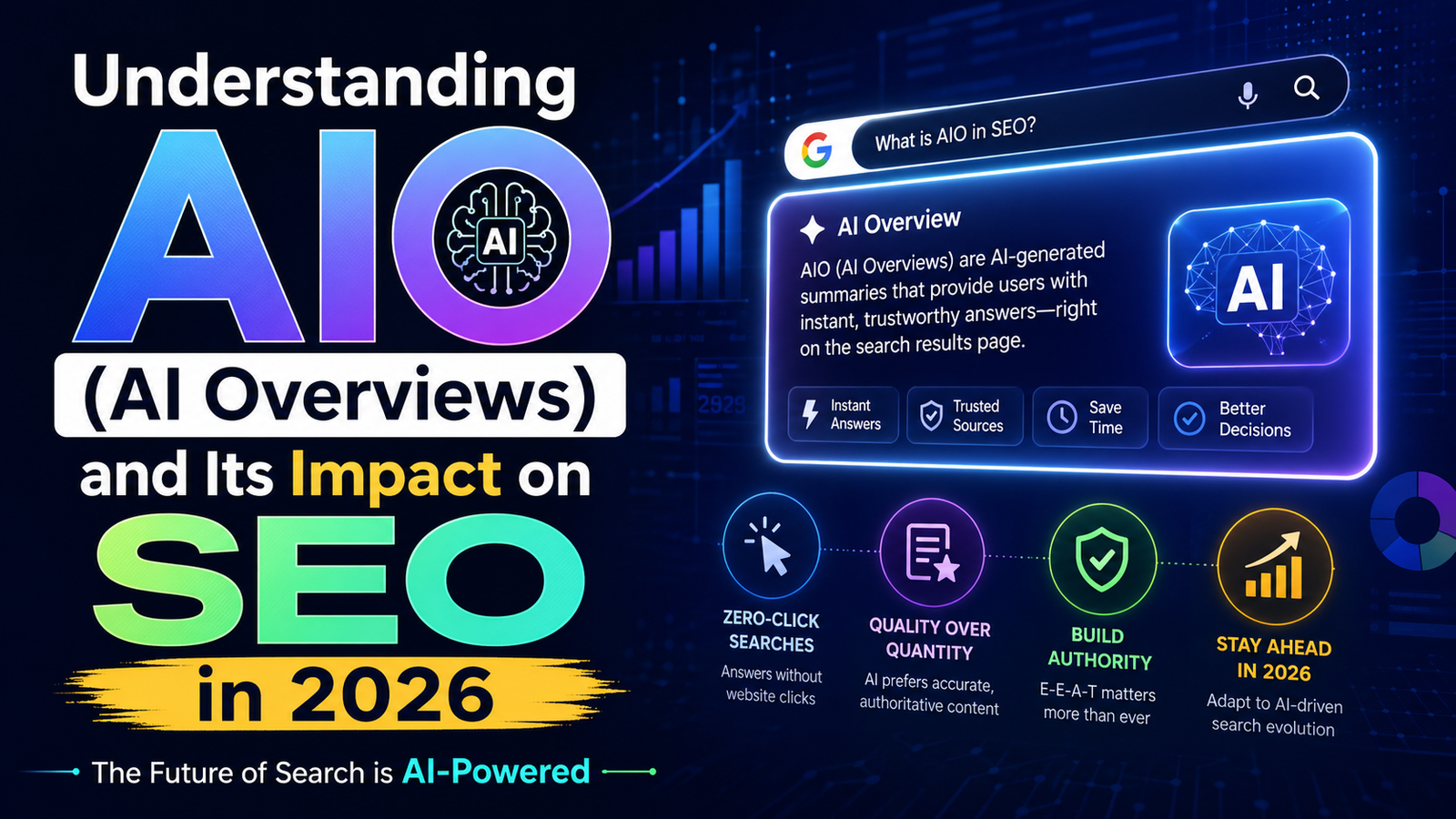
Understanding AIO (AI Overviews) and Its Impact on SEO in 2026
The world of search is evolving faster than ever. With the rise of artificial intelligence, traditional SEO is no longer enough to dominate search rankings. One of the most talked-about changes is AIO (AI Overviews) a feature that is reshaping how users interact with search engines and how businesses optimize their content.
If you're still relying only on traditional SEO strategies, you're already behind. In this guide, we’ll break down everything you need to know about AIO, its impact on SEO, and how you can stay ahead of the curve.
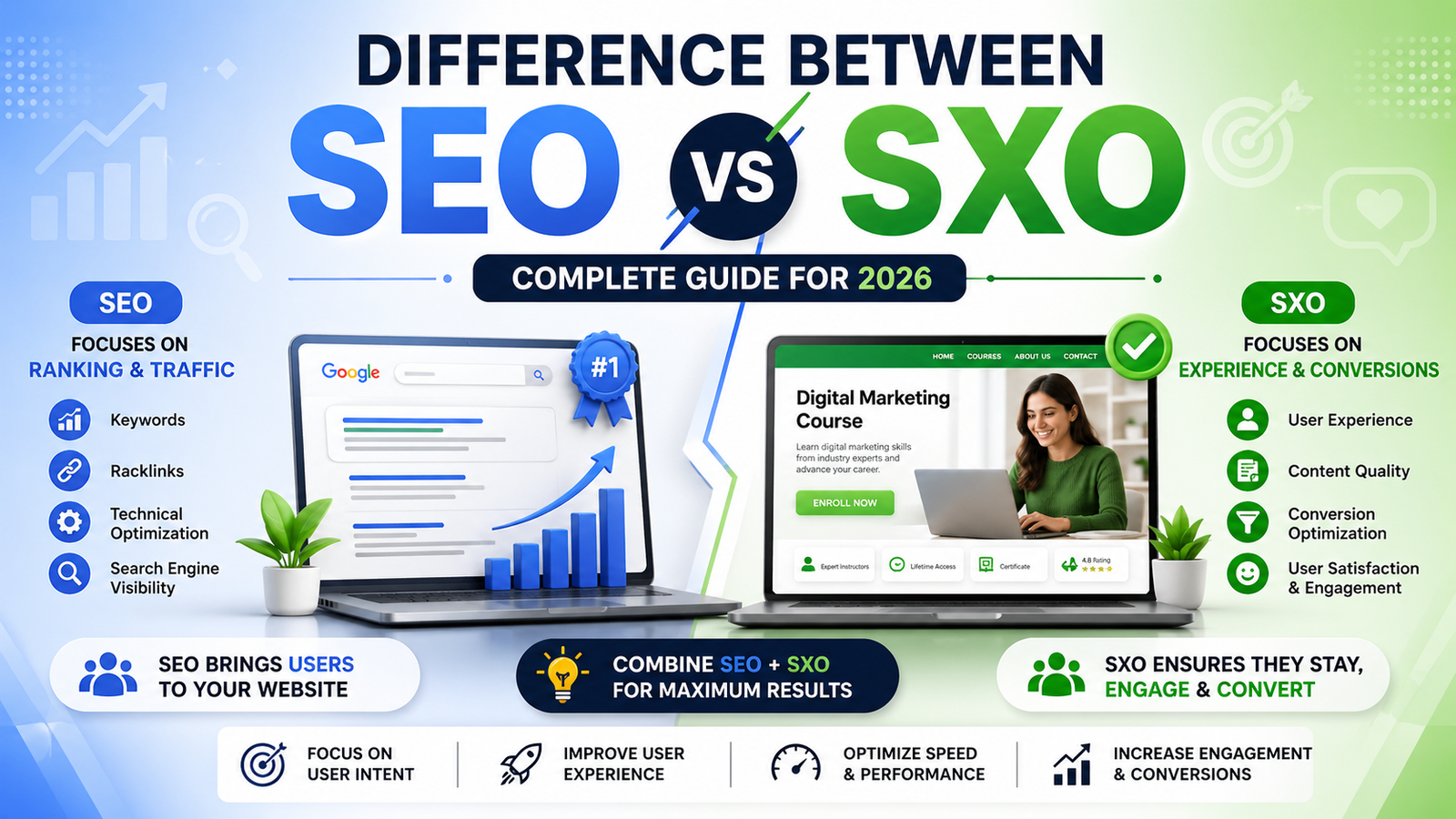
Understand the difference between SEO and SXO and how they work together.
What is AIO for SEO?
AIO (AI Overviews) is a new search feature where AI-generated summaries appear at the top of search engine results, giving users quick, clear answers without needing to visit multiple websites. Instead of showing only links, search engines now combine information from trusted sources and present it in a concise, easy-to-read format.
In simple terms, AIO shifts SEO from just ranking pages to becoming the source of the answer.
How AIO is Changing SEO
AIO is transforming the way content is discovered and consumed:
- Click-based traffic → Answer-based visibility
Your content may be seen and used even if users don’t click your website. - Keyword stuffing → Contextual relevance
Search engines now prioritize meaning, intent, and depth over repetitive keywords. - Ranking pages → Training AI understanding
Content must be structured and authoritative so AI can easily extract and trust it.
Explore strategies for improving agent experience to boost productivity and retention.
How AIO Works
Search engines like Google use advanced AI models to:
- Understand user intent behind a query
- Scan multiple high-quality sources
- Extract key insights
- Generate a summarized response instantly
This means your content competes not just for rankings but for inclusion in AI-generated answers.
Learn what is SXO (Search Experience Optimization) and how it improves rankings and user experience.
Why AIO Matters for SEO
AIO is not just a feature—it’s a major shift in search behavior:
- Lower organic CTR (Click-Through Rate)
Users often get answers directly on the results page. - Higher demand for authority and trust
Only credible, well-structured content is selected by AI. - Increased importance of content quality
Depth, clarity, and accuracy matter more than ever. - Evolution of content discovery
Visibility is no longer limited to rankings it’s about being featured in AI summaries.
Learn what is AXO (Answer Engine Optimization) and how it impacts AI search visibility.
What Does AIO Stand For?
AIO = Artificial Intelligence Overviews
It is part of the broader AI integration in search engines where machine learning models:
- Understand search intent
- Analyze multiple sources
- Deliver summarized answers instantly
AIO vs SEO vs AEO vs GEO: Understanding the Difference
Search has evolved far beyond traditional SEO. Today, it’s a mix of AI-powered summaries, answer-focused content, and generative engines. To stay competitive, you need to understand how AIO, SEO, AEO, and GEO work together—and how they differ.
1. AIO (AI Overviews)
AIO (AI Overviews) represents the newest layer of search, where platforms like Google generate instant summaries at the top of results.
- What it does: Delivers AI-generated answers directly on the SERP
- Focus: Instant, zero-click information
- Strategy: Create clear, structured, and authoritative content that AI can easily extract
👉 Goal: Get featured inside AI summaries, not just ranked below them.
Understand what AIO, GEO, AEO and SXO actually mean and how they shape modern search.
2. SEO (Search Engine Optimization)
SEO is the foundation of all digital visibility. It focuses on improving your website’s position in search results.
- What it does: Helps your website rank higher on search engines
- Focus: Keywords, backlinks, technical performance
- Strategy: Optimize pages, improve site speed, and build authority
👉 Goal: Drive organic traffic through higher rankings.
3. AEO (Answer Engine Optimization)
AEO is about becoming the best answer to a user’s query.
- What it does: Optimizes content for direct answers (featured snippets, voice search)
- Focus: Clear, concise responses to specific questions
- Strategy: Use FAQs, structured data, and question-based content
👉 Goal: Get selected as the featured answer by search engines and voice assistants.
Compare Google Ads vs Meta Ads to choose the right paid advertising platform.
4. GEO (Generative Engine Optimization)
GEO (Generative Engine Optimization) is the future of search, focusing on AI platforms like ChatGPT and Google Bard (now evolving into Gemini).
- What it does: Optimizes content for AI-generated responses
- Focus: Context, depth, and conversational clarity
- Strategy: Write expert-level, human-like content with strong topical authority
👉 Goal: Be cited, referenced, or used in AI-generated answers.
Quick Comparison
| Strategy | Core Focus | End Goal |
| SEO | Rankings | Website traffic |
| AEO | Direct answers | Featured snippets |
| AIO | AI summaries | Zero-click visibility |
| GEO | AI-generated content | AI citations & mentions |
AIO vs SEO
| Feature | AIO | SEO |
| Focus | AI summaries | Website rankings |
| Traffic | Lower clicks, higher visibility | Click-based |
| Strategy | Structured, authoritative content | Keywords & backlinks |
| Goal | Be part of AI answer | Rank #1 on SERP |
👉 Conclusion: SEO is evolving into AIO-driven strategies.
Explore our professional digital marketing course to build in-demand marketing skills.
What is GEO in SEO?
GEO (Generative Engine Optimization) is the next evolution of search optimization, where content is tailored for AI-driven platforms that generate answers instead of just listing links. Unlike traditional SEO, which focuses on rankings, GEO focuses on making your content understandable, trustworthy, and usable by AI systems.
Platforms like ChatGPT and Google Gemini don’t just show results—they create responses by analyzing multiple sources. GEO ensures your content becomes part of those generated answers.
How GEO is Different from Traditional SEO
- SEO: Helps your website rank on search engines
- GEO: Helps your content get used and cited by AI
👉 In GEO, visibility doesn’t just come from clicks—it comes from being referenced in AI-generated responses.
Follow this on-page SEO checklist to improve rankings and website performance.
Core Focus Areas of GEO
To succeed with GEO, your content must be built for both humans and AI:
- Conversational Content
Write in a natural, human tone that mirrors how people ask questions. - Deep Expertise
Provide in-depth, accurate, and well-researched information that demonstrates authority. - Clear Context
Ensure your content is easy to understand, with logical structure and complete explanations. - Structured Data
Use headings, bullet points, FAQs, and schema markup to help AI interpret your content easily.
Why GEO Matters in 2026
- AI tools are becoming primary search platforms
- Users prefer direct, conversational answers
- Traditional rankings alone are no longer enough
GEO ensures your content is not just found—but trusted and used by AI.
Explore our Pinterest marketing guide to grow traffic and sales with proven strategies.
GEO Full Form in SEO
GEO = Generative Engine Optimization
GEO is the next phase of search optimization, evolving beyond traditional SEO and even AEO. While SEO focuses on ranking pages and AEO focuses on answering queries, GEO is about ensuring your content is understood, trusted, and used by AI systems.
With the rise of AI platforms like ChatGPT and advanced search models from Google, content is no longer just ranked—it’s interpreted and generated into responses.
👉 In simple terms:
- SEO → Helps you rank
- AEO → Helps you answer
- GEO → Helps AI use your content
What is SXO in SEO?
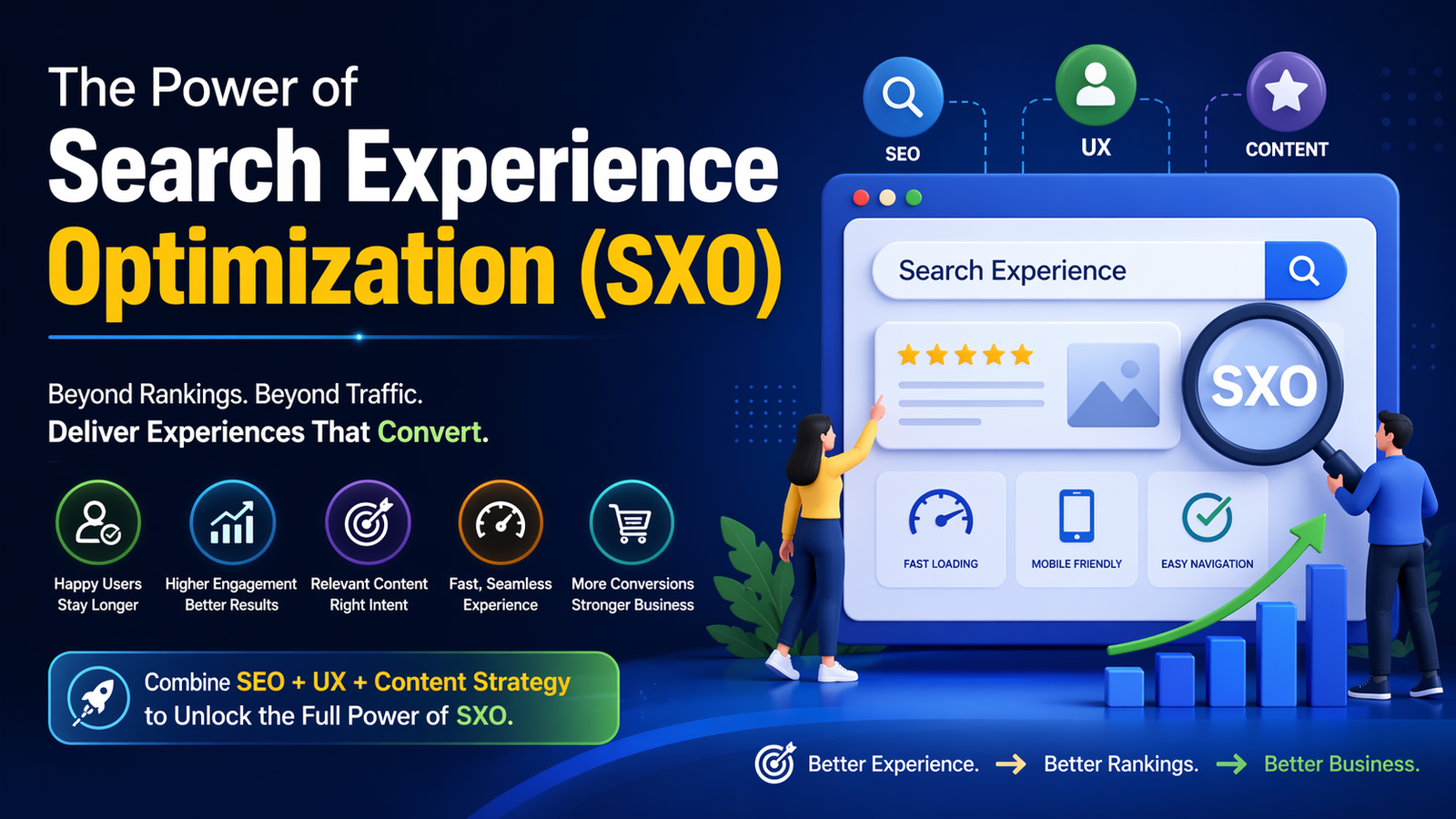
SXO (Search Experience Optimization) is where SEO meets user experience (UX). It focuses not just on bringing users to your website—but ensuring they stay, engage, and convert.
In today’s competitive landscape, ranking alone isn’t enough. If users leave your site quickly, your rankings will eventually drop. SXO solves this by improving the overall experience.
Compare digital marketing course fees in Delhi before choosing the right program.
What SXO Includes
- Fast-Loading Pages
Speed is critical—users expect websites to load in seconds. - Mobile-Friendly Design
A seamless experience across all devices is essential for both users and rankings. - Easy Navigation
Clear menus and intuitive structure help users find what they need quickly. - Engaging Content
High-quality, relevant, and interactive content keeps users interested.
What is AEO in SEO?
AEO (Answer Engine Optimization) focuses on optimizing content to answer user queries directly.
AEO Techniques:
- FAQs
- Structured data
- Featured snippet optimization
- Voice search readiness
Follow this Google My Business ranking guide to improve local search visibility.
AIO vs AEO vs GEO
| Factor | AIO | AEO | GEO |
| Purpose | AI summaries | Direct answers | AI-generated content |
| Platform | Google AI | Search engines & voice assistants | AI tools (ChatGPT, Bard) |
| Strategy | Authority structure | Clear answers | Contextual depth |
The 4 Types of SEO
Understanding the foundation is still important.
1. On-Page SEO
- Keywords
- Content optimization
- Meta tags
2. Off-Page SEO
- Backlinks
- Brand authority
- Social signals
Explore Google Digital Garage to learn free digital marketing skills with certification.
3. Technical SEO
- Website speed
- Mobile optimization
- Crawlability
4. Local SEO
- Google My Business
- Location-based keywords
- Reviews
How AIO is Changing SEO in 2026
The rise of AI Overviews (AIO) is fundamentally reshaping how search works. It’s no longer just about getting users to click—it’s about delivering value instantly. Here’s how AIO is transforming SEO in 2026:
1. Reduced Organic Clicks
With AI-generated summaries appearing at the top of results on platforms like Google, users often get what they need without visiting a website.
👉 What this means for you:
Visibility still matters—but now it’s about being featured in the answer, not just ranking below it.
Explore Google Autocomplete for SEO to find keyword ideas and search intent.
2. Content Quality Over Quantity
Publishing dozens of low-quality articles no longer works. AI systems prioritize content that is:
- Accurate – Fact-checked and reliable
- Authoritative – Backed by expertise and credibility
- Well-structured – Easy for AI to scan and extract
👉 Shift your focus: Create fewer pieces, but make them deep, valuable, and highly optimized.
3. Rise of Zero-Click Searches
AIO has accelerated the trend of zero-click searches, where users find answers directly on the results page.
- No clicks ≠ No value
- Your content can still gain brand visibility and authority
👉 Winning strategy: Optimize for featured snippets, summaries, and direct answers.
Explore software development vs digital marketing in India to compare career paths and growth.
4. Importance of E-E-A-T
Search engines now rely heavily on E-E-A-T (Experience, Expertise, Authority, Trustworthiness) to decide which content gets featured in AI Overviews.
- Experience: Real-world insights and practical knowledge
- Expertise: Subject-matter depth
- Authority: Recognition in your niche
- Trustworthiness: Accurate, transparent, and reliable content
👉 Bottom line: If AI doesn’t trust your content, it won’t use it.
How to Optimize for AIO (AI Overviews)
Ranking on search engines is no longer enough—you need to position your content to be selected by AI. Optimizing for AIO means making your content easy to understand, trustworthy, and ready to be featured in AI-generated summaries on platforms like Google.
Here’s how you can do it effectively:
Explore best digital marketing courses in Delhi to compare top training options.
1. Create Structured, AI-Friendly Content
AI systems prefer content that is well-organized and easy to scan.
Use:
- Clear headings (H1, H2, H3)
- Bullet points and numbered lists
- Short, concise paragraphs
- FAQ sections for direct answers
👉 Pro Tip: Structure your content like a guide—this increases the chances of being picked for AI summaries.
2. Focus on Intent-Based Keywords
Forget keyword stuffing—modern SEO is about understanding user intent.
Include LSI (Latent Semantic Indexing) keywords naturally, such as:
- AI SEO trends 2026
- AI search optimization
- Google AI overview ranking
- Zero-click searches
- AI content visibility
👉 Goal: Match what users are really asking, not just what they’re typing.
Learn how to build a portfolio for digital marketing jobs to showcase your skills effectively.
3. Use Schema Markup
Schema markup helps search engines and AI systems interpret your content more accurately.
- Add FAQ schema
- Use structured data for articles
- Highlight key information clearly
👉 This increases your chances of appearing in rich results and AI Overviews.
4. Build Strong Authority
AI systems prioritize content from credible and trusted sources.
How to build authority:
- Publish expert-level, in-depth content
- Earn backlinks from high-authority websites
- Maintain consistency in your niche
- Showcase real experience and insights
👉 Remember: If your content isn’t trusted, it won’t be featured.
Explore prompt engineering for marketers to create better AI-driven campaigns and content.
5. Optimize for Featured Snippets
AIO often pulls data from featured snippet-ready content.
To optimize:
- Answer questions directly in 40–60 words
- Use question-based headings (e.g., “What is AIO?”)
- Provide clear, concise definitions
👉 Think of snippets as the gateway to AI Overviews.
Why Learning Modern SEO is Critical
The rules of digital marketing have changed. Today, it’s not just about ranking on search engines—it’s about how AI understands, selects, and presents your content. With the rise of AIO (AI Overviews), AEO (Answer Engine Optimization), and GEO (Generative Engine Optimization), traditional SEO alone is no longer enough.
If you want to stay relevant and competitive in 2026 and beyond, you need to adapt to AI-driven search behavior. Businesses are actively looking for professionals who understand how to optimize content not just for search engines, but also for AI-powered platforms.
In short:
- SEO gets you visibility
- AEO makes you the answer
- GEO ensures AI trusts and uses your content
- AIO determines whether you get featured
That’s why learning modern SEO is no longer optional—it’s a career necessity.
Learn what is digital marketing and how it works for beginners.
Learn Advanced SEO with Industry Experts
To truly master these skills, you need practical, hands-on training—not just theory.
Upgrade your career with professional training at Code with TLS, where you learn real-world SEO strategies that actually work in today’s AI-driven landscape.
Why Choose Us?
- 50 Advanced SEO Modules covering latest trends
- AI SEO & AIO Strategies included in the curriculum
- Live Projects & Case Studies for practical experience
- Placement Assistance to kickstart your career
- Industry-Recognized Certifications
📞 Call Us
📧 Email Us
📍 Visit Us
2/81-82, Ground Floor, Lalita Park, Gali No - 2, Laxmi Nagar, New Delhi - 110092
Don’t just learn SEO—master the future of search.
Start your journey today and become an AI-powered SEO expert 🚀
FAQs on AIO, SEO, AEO, and GEO
1. What is AIO for SEO?
AIO (AI Overviews) is an AI-generated summary shown in search results that provides direct answers, reducing the need to click websites.
2. What does AIO stand for?
AIO stands for Artificial Intelligence Overviews.
3. What are the 4 types of SEO?
The four main types are:
- On-page SEO
- Off-page SEO
- Technical SEO
- Local SEO
4. What is AIO vs SEO vs AEO?
- SEO focuses on ranking websites
- AEO focuses on answering queries
- AIO delivers AI-generated summaries
5. What is GEO in SEO?
GEO (Generative Engine Optimization) is optimizing content for AI platforms that generate responses instead of listing links.
6. What is SXO in SEO?
SXO (Search Experience Optimization) improves both SEO and user experience for better engagement and conversions.
7. What is AEO in SEO?
AEO is optimizing content to provide direct answers for search queries and voice assistants.
8. What is GEO full form in SEO?
GEO stands for Generative Engine Optimization.
9. AIO vs SEO – which is better?
Both are important. SEO helps you rank, while AIO ensures your content appears in AI-generated summaries.
10. AIO vs AEO vs GEO – what’s the difference?
- AIO = AI summaries
- AEO = Answer optimization
- GEO = AI-generated platform optimization
Final Thoughts
The future of SEO is no longer just about ranking—it’s about being understood by AI.
With AIO, AEO, GEO, and SXO shaping the digital landscape, businesses must adapt quickly or risk becoming invisible.
👉 If you want to dominate search in 2026 and beyond, now is the time to upgrade your skills and embrace AI-driven SEO strategies.
Recent Posts
- Understanding AIO (AI Overviews) and Its Impact on SEO in 2026
 Difference Between SEO and SXO: Complete Guide for 2026
 The Power of Search Experience Optimization (SXO)
 What is Agent Experience Optimization (AXO)? A Complete Guide for 2026
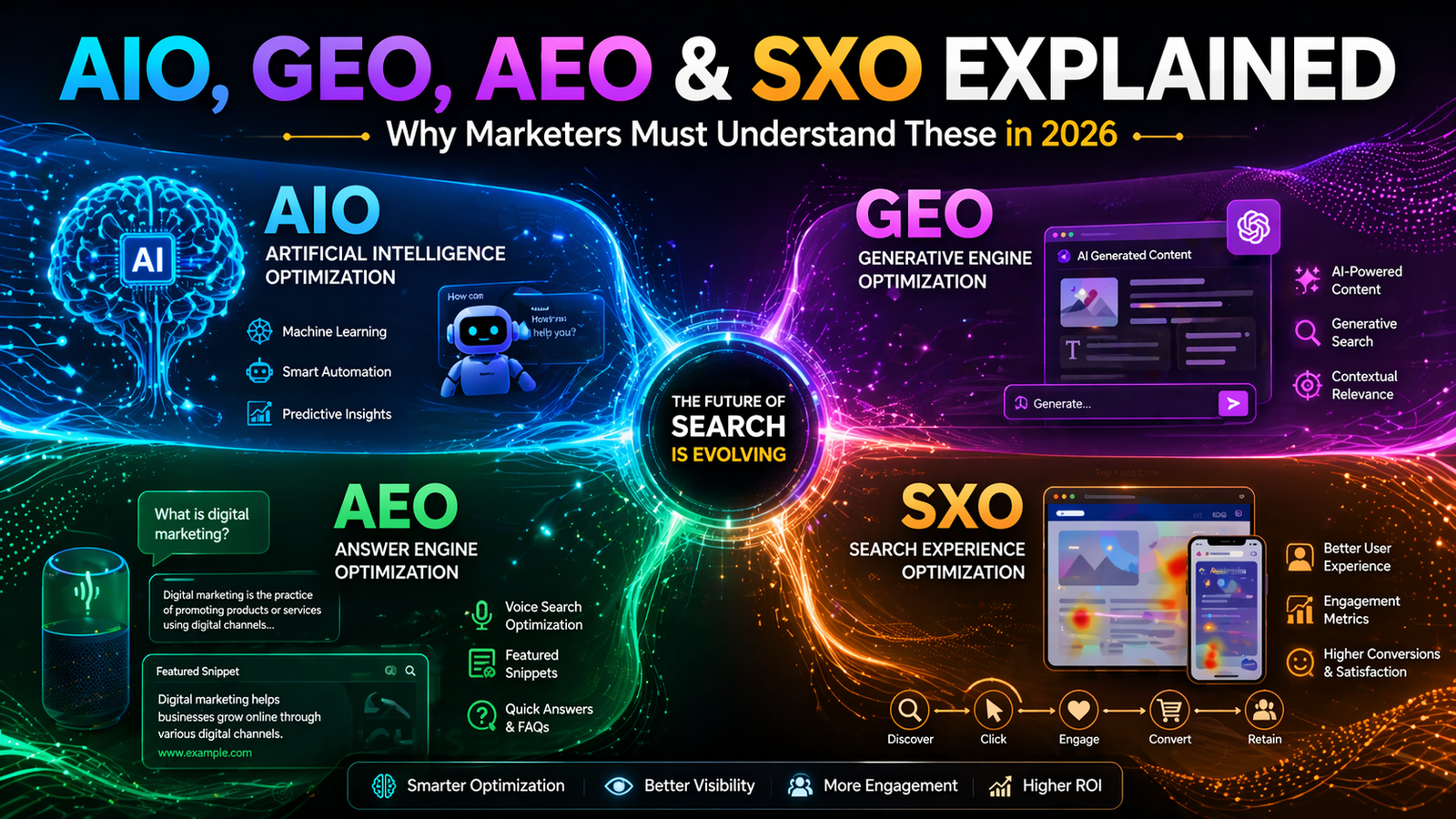 What AIO, GEO, AEO, and SXO Actually Mean — and Why Marketers Should Care
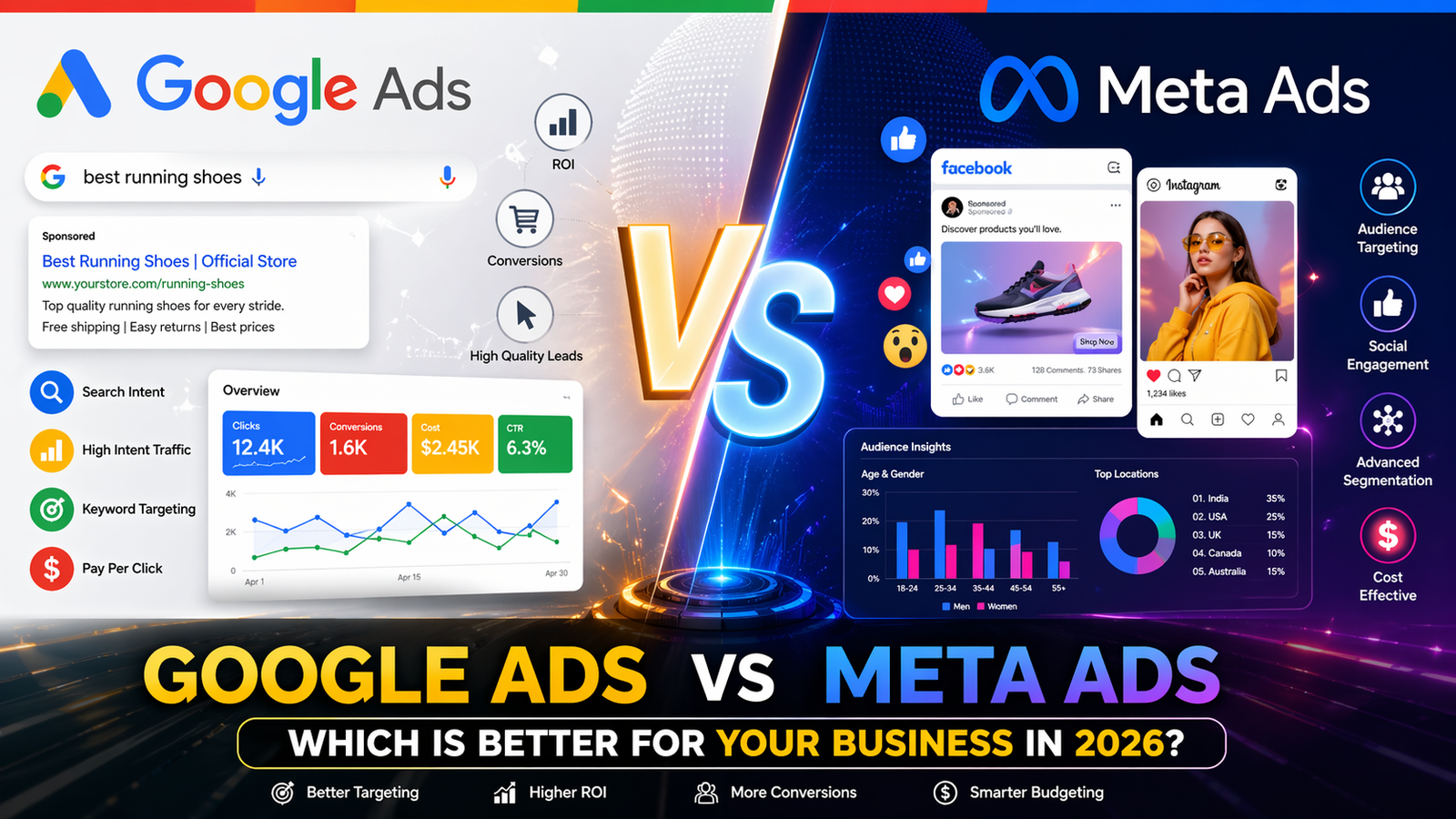 Google Ads vs Meta Ads — Which Is Better for Your Business in 2026?
 On-Page SEO Checklist for 2026 (Step-by-Step Guide)
 What is GMB & How to Rank on Google My Business in 2026 (Complete Guide)
 Google Digital Garage: Courses List, Certificates & Career Opportunities
 Prompt Engineering for Digital Marketers: Boost AI Results