
What Is SEO and How It Works in 2026 -Guide for Beginners
SEO (Search Engine Optimization) is the smart process of optimizing your website so that it ranks higher on search engines like Google helping you attract the right audience organically, without paying for ads.
Simply put, SEO makes your website discoverable.
It connects your content with people who are already searching for what you offer.
Without SEO, even the best website can stay hidden. No matter how great your product, service, or content is if users can’t find you on Google, you miss valuable traffic, leads, and growth opportunities.
What is Seo? ( Search Engine Optimization )
SEO stands for Search Engine Optimization. At its core, it is the process of improving your website so that it ranks higher in search results on engines like Google, Bing, or Yahoo when people look for products or information related to your business.
The ultimate goal of SEO is to attract organic traffic visitors who find you naturally through search results rather than through paid advertisements.
Its purpose is simple: to help your website appear when people are actively searching for information, products, or services related to your business.
The primary objectives of SEO are to:
- Achieve higher rankings on search engine results pages (SERPs)
- Attract users who are genuinely interested in your offerings
- Generate consistent organic (non-paid) traffic
- Build online authority, credibility, and trust
For example, when a user searches for “best digital marketing course in Delhi,” search engines display websites that are relevant, trustworthy, and well-optimized. SEO is the process that ensures your website earns a place among those top results — making it visible to the right audience at the right time.
How Does SEO Work?
SEO (Search Engine Optimization) is the process of making your website more visible on search engines like Google. When people search for words related to your business or interests, SEO helps your site show up as high as possible in the "organic" (non-paid) results.
Think of a search engine as a digital librarian. To help you find the right book, the librarian needs to know what every book in the library is about and which ones are the most helpful.
To understand how search is evolving in the digital world, explore our article on AEO changing the future of search engine optimization.
How Search Engines Work
1. Crawling: The Discovery Phase
What it is: This is how search engines find out that your webpage even exists.
- The "Crawlers": Search engines use automated software programs called bots, spiders, or crawlers (Google’s is called "Googlebot").
- How they move: They don't just wander aimlessly; they follow links. A bot starts on a page it already knows, finds a link to a new page, and "crawls" over to it.
- Discovery Tools: You can help them find you faster by submitting a Sitemap (a list of all your pages) via Google Search Console.
- The Barrier: If you block a page in your robots.txt file, you’re essentially putting a "No Trespassing" sign up for the crawler.
2. Indexing: The Storage Phase
What it is: Once a bot finds a page, it tries to understand what it’s about and saves it in a giant database.
- The "Index": Think of this as the library's catalog. If a page isn't in the index, it cannot show up in search results.
- Analysis: The search engine looks at the text, images, and video files to categorize the page. It also "renders" the page, meaning it looks at the code (HTML/JavaScript) to see how it appears to a real person.
- Selection: Google doesn't index every single page it crawls. If a page has very little content, is a duplicate of another page, or is low quality, Google may choose to leave it out of the index.
3. Ranking: The Selection Phase
What it is: This is the magic part where the search engine decides which indexed pages are the "best" answers for a specific search.
- The Algorithm: When you type "how to bake bread," Google looks through its index (billions of pages) and picks the top results in milliseconds using complex math.
- Key Ranking Factors:
- Relevance: Does the content actually answer the user's question?
- Authority (Backlinks): Do other trusted websites link to this page?
- User Experience: Does the page load fast? Is it easy to read on a phone?
- E-E-A-T: Does the author have Experience and Expertise?
Summary Table
| Process | Goal | Analogy |
| Crawling | Discovery | Driving around a city to find new buildings. |
| Indexing | Understanding | Taking a photo of the building and filing it in a folder. |
| Ranking | Sorting | Recommending the best building to visit for a specific need. |
Why Is SEO Important?
SEO is important because it connects your website with people who are actively searching for what you offer. Instead of interrupting users with ads, SEO attracts visitors naturally making it one of the most powerful and cost effective digital marketing strategies.
If you're wondering about eligibility before enrolling, read can I do digital marketing course after 12 to get clarity on requirements.
Here’s why SEO truly matters:
- Increases website visibility: Higher rankings mean more people see and visit your website.
- Drives targeted traffic: SEO brings users who already have interest or intent, resulting in better conversions.
- Builds trust and credibility: Websites that rank on the first page are perceived as more reliable and authoritative.
- Provides long term results: Unlike ads that stop when your budget ends, SEO continues to generate traffic over time.
- Improves user experience: SEO encourages faster loading, mobile optimization, and better site structure all improving usability.
- Delivers higher ROI: Organic traffic often converts better than paid traffic, making SEO highly profitable.
- Supports brand growth: Consistent visibility builds recognition and strengthens your online presence.
In today’s digital world, SEO is not optional it’s essential. Whether you're running a business, building a personal brand, or growing an online platform, SEO ensures that your audience can find you, trust you, and choose you over competitors.
The Three Pillars of SEO
To rank well, you need to focus on three different areas:
A. On-Page SEO (The Content)
This is about making individual pages easy for both users and bots to understand.
- Keyword Research: Identifying the actual words people type into Google (e.g., "best running shoes for flat feet" vs. just "shoes").
- Content Quality: Creating "Satisfying Content" that actually answers the user's question. In 2025, Google prizes Topical Coverage (the depth of your info) over just repeating keywords.
- HTML Tags: Placing your keywords in the Title Tag, Meta Description, and Headings (H1, H2) so the bot knows exactly what the page is about.
B. Technical SEO (The Backend)
This ensures that search engines can easily access and "read" your site.
- Site Speed: If your site takes more than a few seconds to load, Google will rank you lower because it's a bad experience for users.
- Mobile-First: Most searches happen on phones. Your site must look and work perfectly on mobile devices.
- Security: Using HTTPS (the "lock" icon in your browser) is a standard requirement for trust.
C. Off-Page SEO (The Reputation)
This is about proving to Google that your site is an authority.
- Backlinks: When another reputable website links to yours, it acts like a "vote of confidence." The more high quality votes you have, the more Google trusts you.
- E-E-A-T: This stands for Experience, Expertise, Authoritativeness, and Trustworthiness. Google looks for signals that the author actually knows what they are talking about.
Why SEO Takes Time
Unlike paid ads, SEO isn't an "on/off" switch. It usually takes 3 to 6 months to see significant results because:
- Bots need time to find and re-index your changes.
- You have to build up a history of providing helpful content.
- Trust (backlinks) must be earned naturally over time.
Avoid "Black Hat" SEO tactics like keyword stuffing (hiding invisible keywords on a page) or buying fake links. Google’s AI is very good at spotting these, and they can get your site banned from search results entirely.
Would you like me to help you find some "seed keywords" for a specific topic or business you're working on?
For a structured approach to learn from basics, follow our step-by-step guide on learn digital marketing step by step.
How Keywords Work in SEO
Keywords are the words and phrases that people type into search engines when they are looking for information, products, or services. In SEO, keywords act as the bridge between what users search for and the content you provide.
When your website uses the right keywords in the right places, search engines can understand what your page is about and show it to users who are searching for those terms.
How Keywords Connect Users and Content
For example, if someone searches for “digital marketing course in Delhi,” Google looks for pages that include this phrase and offer relevant, helpful information about it. If your content is well optimized for that keyword, your page has a higher chance of appearing in the results.
Types of Keywords in SEO
- Short-tail keywords: Broad and high volume (e.g., SEO, digital marketing)
- Long-tail keywords: More specific and intent focused (e.g., best SEO training in Delhi for beginners)
- Informational keywords: Used when users want knowledge (e.g., what is SEO, how SEO works)
- Commercial keywords: Used when users compare options (e.g., best SEO course, SEO tools comparison)
- Transactional keywords: Used when users are ready to act (e.g., buy SEO course, enroll in SEO training)
Where to Use Keywords
Keywords should be placed naturally in:
- Page titles and meta descriptions
- Headings (H1, H2, H3)
- Body content
- URLs
- Image alt text
Why Keywords Matter
- Help search engines understand your content
- Match your content to user intent
- Increase your chances of ranking higher
- Improve relevance and click-through rates
In short, keywords guide search engines to your content and guide users to your website making them a foundational element of every successful SEO strategy.
SEO Ranking Factors
SEO ranking factors are the criteria search engines use to decide which pages appear first in search results. Google considers hundreds of signals, but a few core factors have the biggest impact on your rankings.
If you prefer remote learning, check out our comprehensive article on how to learn digital marketing online effectively.
Understanding these helps you focus on what truly improves visibility.
1. High Quality Content
Search engines prioritize content that is:
- Helpful, original, and informative
- Well structured and easy to read
- Updated and accurate
Quality content satisfies user intent which is Google’s top priority.
2. Keyword Relevance
Your content must clearly match what users are searching for by using:
- Primary and secondary keywords naturally
- Keywords in headings, titles, and body content
This helps search engines understand your topic.
3. Page Experience
Google favors websites that provide a smooth user experience, including:
- Fast loading speed
- Mobile responsiveness
- Clear navigation
- No intrusive pop-ups
4. Backlinks (Authority)
Backlinks are links from other websites pointing to yours. They signal trust and authority.
- High quality links from relevant sites boost rankings
- Low quality or spammy links can harm your site
5. Technical SEO Health
Search engines prefer technically sound websites:
- Secure HTTPS connection
- Clean URL structure
- XML sitemap and proper indexing
- No broken links or crawl errors
6. User Behavior Signals
Google observes how users interact with your site:
- Click-through rate (CTR)
- Time spent on page
- Bounce rate
Positive engagement signals relevance and usefulness.
7. Content Freshness
Updated content performs better, especially for time-sensitive topics.
8. Local Signals (for Local SEO)
For local searches, rankings depend on:
- Google Business Profile optimization
- Reviews and ratings
- Location relevance
Why Ranking Factors Matter
SEO ranking factors guide search engines in delivering the best possible results to users. By aligning your website with these factors, you increase your chances of appearing higher, attracting more traffic, and building long term visibility.
Focusing on quality, relevance, experience, and trust is the key to sustainable SEO success.
To compare modern practices with conventional methods, read our analysis on AI vs traditional marketing.
The Role of Content in SEO
Content is the heart of every successful SEO strategy. Without strong content, even the best technical optimization cannot deliver long-term results.
Search engines rank pages that provide real value to users. That means your content should not just include keywords it should educate, solve problems, and guide readers.
High performing SEO content is:
- Useful: It answers questions and provides practical insights.
- Clear and readable: Simple language makes it accessible to everyone.
- Well-organized: Logical headings and structure improve readability.
- Fresh and updated: Regular updates keep information relevant.
- Original and credible: Unique content builds trust with users and search engines.
Your content should always aim to fully satisfy the user’s search intent not just attract clicks, but deliver real answers.
Common SEO Mistakes to Avoid
Even small SEO mistakes can prevent your website from ranking well. Being aware of them helps you stay ahead.
You can also learn about the next phase of AI-driven strategy through our guide on generative engine optimization (GEO).
Avoid these common errors:
- Overusing keywords unnaturally, which harms readability and rankings.
- Publishing duplicate or copied content, which reduces trust and visibility.
- Allowing your website to load slowly, leading to poor user experience.
- Neglecting mobile optimization, even though most users browse on phones.
- Acquiring spammy or irrelevant backlinks, which can trigger penalties.
- Leaving old content outdated, which lowers relevance and authority.
By avoiding these mistakes and focusing on quality, relevance, and usability, you create a website that both users and search engines value which is the true goal of SEO.
Essential SEO Tools You Should Know
SEO tools help you understand what’s working, what’s not, and where opportunities exist. They provide data driven insights that guide smarter optimization decisions.
Some of the most widely used and effective SEO tools include:
- Google Search Console: Helps monitor indexing, search performance, and technical issues.
- Google Analytics: Tracks visitor behavior, traffic sources, and conversions.
- SEMrush: Offers keyword research, competitor analysis, and site audits.
- Ahrefs: Specializes in backlink analysis and content research.
- Screaming Frog: Crawls your website to identify technical SEO problems.
- Ubersuggest: A beginner-friendly tool for keyword ideas and SEO insights.
Together, these tools allow you to track rankings, analyze competitors, find keyword opportunities, and continuously improve your SEO performance.
How Long Does SEO Take to Show Results?
SEO is a gradual process, not an overnight solution. It requires consistent effort, patience, and optimization.
A typical SEO timeline looks like this:
- First 1–3 months: Technical fixes, content optimization, and indexing improvements
- Next 3–6 months: Keyword rankings start improving and traffic begins to grow
- After 6–12 months: Strong, stable organic traffic and higher conversion rates
Because SEO builds authority over time, its impact continues to grow. The longer you invest in SEO, the stronger and more sustainable your results become making it one of the most powerful long-term digital growth strategies available.
SEO for Businesses
SEO is no longer optional for businesses it’s a growth engine.
When done right, SEO helps businesses:
- Attract high intent leads consistently without paying for every click
- Build long term brand authority in their industry and location
- Lower customer acquisition costs by reducing dependence on ads
- Reach customers at the exact moment they’re searching for solutions
- Outperform competitors who rely only on paid marketing
Instead of interrupting people with ads, SEO brings your brand in front of users who are already interested making conversions easier and more cost effective.
SEO as a Career
SEO has evolved into one of the most in demand digital skills across industries.
Today, SEO professionals are needed by:
- Startups
- E-commerce brands
- IT companies
- Agencies
- Global enterprises
Popular SEO career roles include:
- SEO Executive
- SEO Analyst
- Content & Keyword Strategist
- Technical SEO Specialist
- Digital Growth Manager
With the rise of AI, voice search, and mobile first indexing, skilled SEO professionals are becoming even more valuable.
Salary Potential in India:
With proper training and hands-on experience, SEO professionals can earn between ₹30,000 to ₹1,50,000+ per month, and senior experts or consultants can earn significantly more.
SEO offers:
- High demand
- Global career opportunities
- Freelancing and remote work options
- Long term career stability
It’s not just a job it’s a future proof digital career.
Why Choose Code with TLS to Learn SEO
At Code with TLS, SEO is taught as a real world skill not just a theory subject. Our training is designed to make you job-ready, confident, and capable of handling live client projects from day one.
Here’s what makes our SEO program different:
- Hands on, practical training with real websites and live ranking projects so you don’t just learn you apply.
- Advanced keyword research and competitor strategy so you understand exactly how to outrank competitors, not just analyze them.
- Complete coverage of on-page, off-page, and technical SEO, taught in a simple step by step format.
- Professional tools training including Ahrefs, SEMrush, Google Analytics 4, and Google Search Console.
- Local SEO and conversion optimization techniques to help businesses generate real leads, not just traffic.
- Career support, certifications, and placement guidance to help you confidently enter the job market or start freelancing.
Whether you're a student, working professional, or business owner, Code with TLS equips you with the skills, tools, and mindset needed to succeed in modern SEO and digital marketing.
Conclusion
SEO is no longer just a marketing tactic it’s the foundation of online visibility and digital growth. It helps the right people discover the right content at exactly the right moment.
When you understand how SEO works and apply it correctly, you don’t just gain traffic you build trust, authority, and sustainable success in the digital world.
Whether you're running a business, building a personal brand, or shaping your career in digital marketing, SEO gives you a long term advantage that paid ads and short term strategies cannot replace.
Start mastering SEO today with expert led training from Code with TLS and transform your skills into real world impact and career opportunities.
Call Us
+91 85278 66980
Email Us
Visit Us
2/81-82, Ground Floor, Lalita Park, Gali No - 2, Laxmi Nagar, New Delhi - 110092
FAQ
1. What is SEO and how it works with examples?
SEO (Search Engine Optimization) is the process of improving a website so it ranks higher on search engines like Google. It works by optimizing content, keywords, website structure, and links.
Example:
If someone searches for “best digital marketing course in Delhi” and your website appears on the first page because you optimized that page with the right keywords, fast loading speed, and good content that is SEO working.
2. What is SEO and how it works PDF?
A “What is SEO and how it works PDF” is a downloadable guide that explains SEO basics, techniques, and examples in a simple document format. Many institutes and blogs provide free PDFs to help beginners understand SEO concepts offline.
3. What is SEO and how it works in digital marketing?
In digital marketing, SEO is used to attract organic (free) traffic from search engines. It helps businesses reach people who are already searching for their products or services online, making SEO one of the most cost-effective and high-converting digital marketing strategies.
4. What is SEO in digital marketing?
SEO in digital marketing means optimizing websites, content, and technical elements to improve visibility on search engines. It supports other channels like content marketing, social media, and paid ads by increasing brand authority and trust.
5. What is search engine optimization?
Search Engine Optimization is the practice of improving a website so that search engines can easily understand, trust, and rank it higher in search results. It includes keyword research, content optimization, technical improvements, and link building.
6. Search engine optimization example
Example:
A dentist optimizes their website for “best dentist in Noida” by:
- Adding that keyword in page titles and content
- Getting reviews on Google
- Improving website speed
As a result, their clinic appears on top when users search for dentists in Noida.
7. How to do SEO?
To do SEO effectively:
- Research keywords
- Optimize website content
- Improve page speed and mobile usability
SEO is an ongoing process, not a one-time task.
8. How to do SEO for a website step-by-step?
Here is a simple step-by-step SEO process:
- Do keyword research
- Optimize page titles and meta descriptions
- Create high quality, helpful content
- Use internal linking
9. Is SEO easy to learn for beginners?
Yes. SEO is beginner friendly if you learn it step by step with proper guidance and practical examples. With regular practice, anyone can master SEO regardless of technical background.
10. How long does SEO take to show results?
SEO usually takes 3 to 6 months to show noticeable results, depending on competition, industry, and how well the optimization is done.
Recent Posts
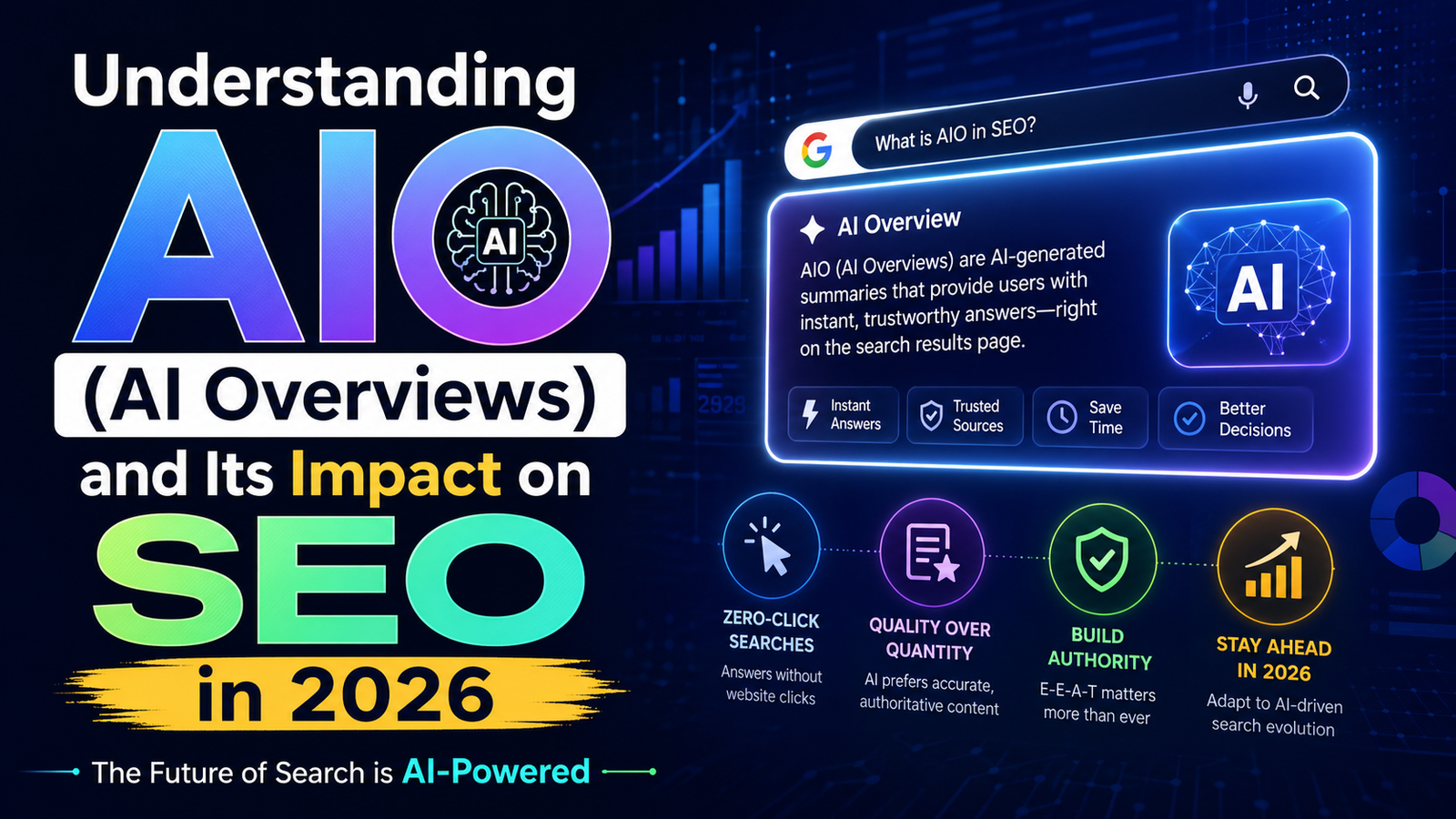 Understanding AIO (AI Overviews) and Its Impact on SEO in 2026
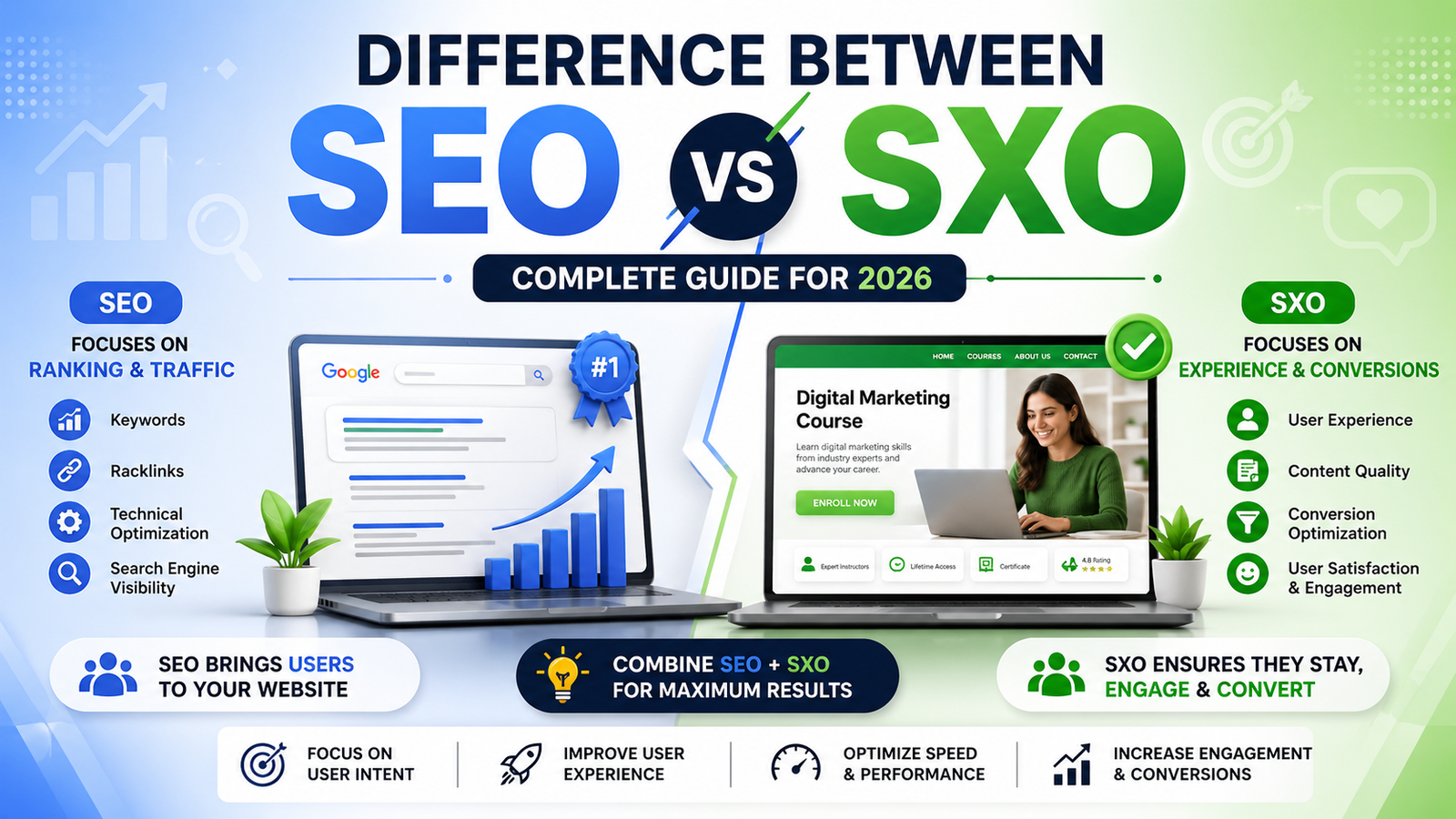 Difference Between SEO and SXO: Complete Guide for 2026
 The Power of Search Experience Optimization (SXO)
 What is Agent Experience Optimization (AXO)? A Complete Guide for 2026
 What AIO, GEO, AEO, and SXO Actually Mean — and Why Marketers Should Care
 Google Ads vs Meta Ads — Which Is Better for Your Business in 2026?
 On-Page SEO Checklist for 2026 (Step-by-Step Guide)
 What is GMB & How to Rank on Google My Business in 2026 (Complete Guide)
 Google Digital Garage: Courses List, Certificates & Career Opportunities
 Prompt Engineering for Digital Marketers: Boost AI Results